Health Innovation Manchester: 2025 in Review
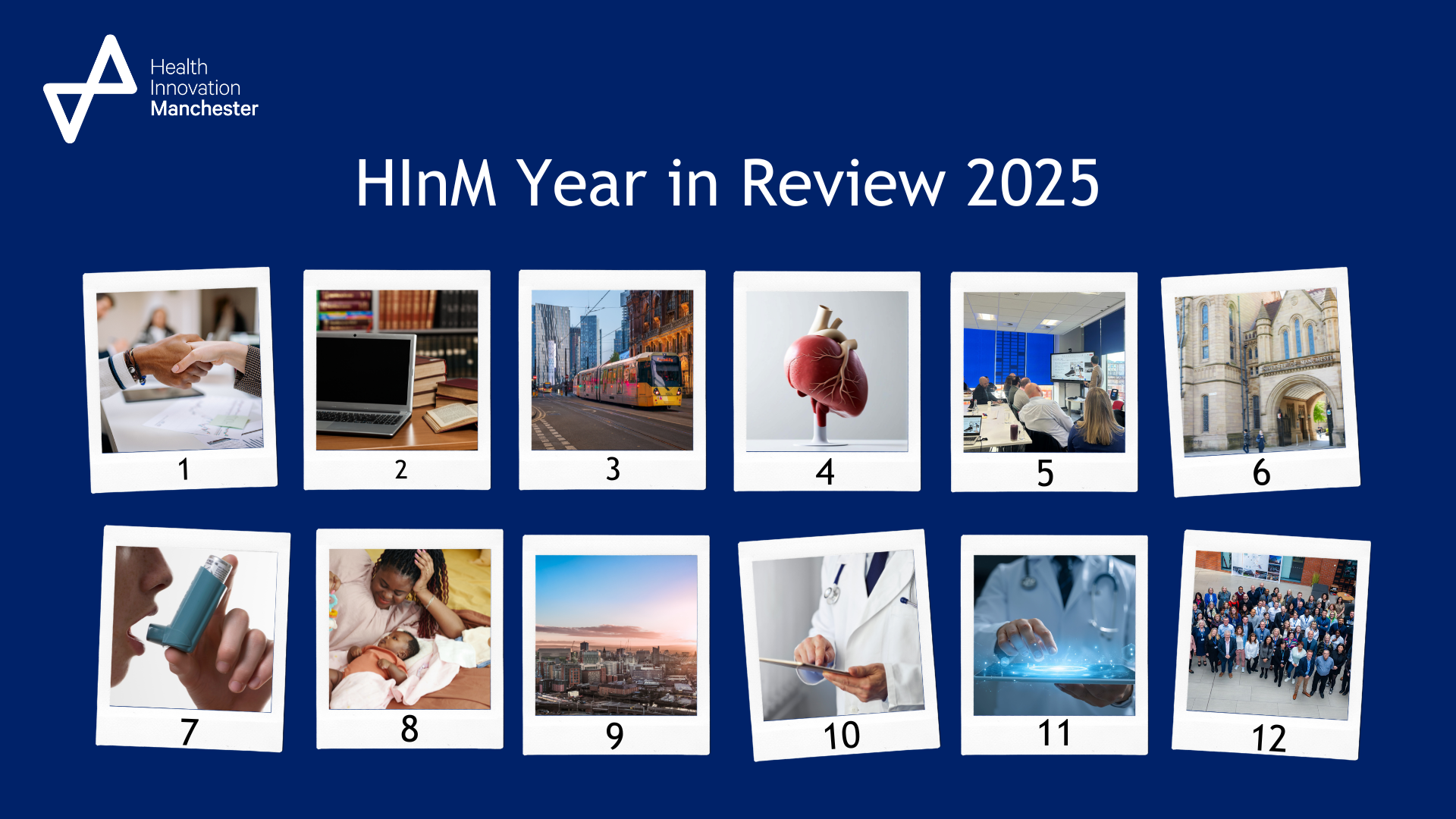
As 2025 draws to a close, we’re taking the opportunity to look back on a year of meaningful progress across Health Innovation Manchester. From driving forward new research to deepening partnerships and rolling out innovative solutions, 2025 has been a year of real momentum for our health and social care system.
This December, Health Innovation Manchester (HInM) will be shining a light on some of the moments that defined our year.
For the next 12 days, we’ll reveal a new highlight each day, showcasing the projects, collaborations, and breakthroughs that have created tangible benefits for people and communities across the region. We invite you to join us as we revisit these achievements and celebrate the collective effort behind them.
Explore our 2025 highlights by clicking through the tabs below.
We are thrilled to celebrate a series of new appointments and strategic developments that were appointed over the past year, setting us up for even greater impact.
We were delighted to welcome Professor Dame Nancy Rothwell as our new Global Ambassador, whose exceptional leadership and global-scale experience will help elevate Greater Manchester as a worldwide hub for health innovation.
Strengthening our executive team further, Laura Rooney became Deputy Chief Executive / Chief Strategy Officer, and Claire Macconnell became Chief Operating Officer – both bringing deep commitment to driving delivery, partnerships and system transformation.
We have also welcomed three great local leaders to our Board: Councillor Bev Craig, Anthony Hassall, and Professor Ashley Blom – each bringing unique expertise in civic leadership, NHS delivery and academic excellence to help steer our mission.
To further strengthen our commercial leadership and global outreach, Steve Oldfield CB has been appointed Deputy Chair, enhancing our ability to build partnerships and scale innovation for the benefit of people in Greater Manchester and beyond.
In October, we celebrated Professor Ben Bridgewater’s appointment as Executive Chair of the Health Innovation Network – a national recognition of the leadership and transformation Ben has helped drive within HInM and Greater Manchester, and an opportunity to extend our impact across England.
At the start of December, we announced the appointment of a new Chief Medical Officer, Dr. Vish Mehra. Vish has worked across Greater Manchester for more than 25 years and brings extensive experience in clinical leadership, system transformation, and innovation at scale.
These new appointments, combined with the strong foundations detailed in our 2024–25 Annual Impact Report, have set a bold tone for the future. With renewed leadership and expanded reach, we are better placed than ever to innovate at pace, partner globally, and deliver tangible improvements in health and care for the people of Greater Manchester and beyond.
This year, we shone a spotlight on the exceptional research leaders driving discovery and innovation across Greater Manchester through our Leadership in Research blog series.
We heard from inspiring figures shaping the future of health and care research:
- Dr Chathurika Kannangara, championing inclusive research and strengthening the pipeline of future innovators.
- Professor Deborah James, whose work continues to improve patient-centred research and outcomes across the region.
- Professor Penny Cook, leading impactful public health research and advocating for community-driven approaches.
- Professor Andy Trafford, sharing insights into translational science and accelerating breakthroughs from lab to clinic.
To complement their stories, we also explored The Role of Research Leadership, highlighting how strong, visionary leadership is essential for guiding innovation, nurturing talent, and delivering discoveries that improve lives.
Together, these voices celebrate the expertise and passion that make Greater Manchester a thriving powerhouse for health research and a place where innovation truly works for everyone.
This year marked major milestones for the Health Innovation Accelerator, with transformational progress across screening, early diagnosis, community engagement and industry collaboration right across Greater Manchester.
We worked hand-in-hand with communities including over 400 local citizens and partners such as the LGBT Foundation to ensure new innovations reflect real needs and improve access to lifesaving screening. This included expanding community-based liver disease testing, pioneering digital tools to identify cardiovascular risk earlier, and strengthening engagement across neighbourhoods to build trust and understanding.
The programme has also accelerated breakthroughs in diagnostics. New rapid genetic testing is helping clinicians tailor treatment for heart attack patients, while innovative ambulance technology is improving the speed and accuracy of heart attack diagnosis before patients even reach hospital. Meanwhile, the region continues to lead the way with lung cancer screening, enabling earlier detection and more personalised care for thousands.
Beyond health outcomes, the Innovation Accelerator continues to boost Greater Manchester’s economy, skills and research capacity and with the programme extended, we are set to deliver even more impact in the years ahead. Together with healthcare partners, industry and our communities, we’re shaping a future where innovation improves lives across every part of our city-region.
The Accelerator encompasses two projects, the Advanced Diagnostics Accelerator (ADA) and the DEVOTE programme, delivered through a partnership between Health Innovation Manchester, Manchester University NHS Foundation Trust (MFT), The University of Manchester, and industry partners.
In June, a new report from HInM, together with Frontier Economics and NHS Greater Manchester, revealed just how urgent the need for cardiovascular innovation is in our region. Each year, cardiovascular disease (CVD) costs Greater Manchester an estimated £2.53 billion affecting individuals, families, communities, and public services alike.
The human toll is stark: nearly 5,500 lives lost annually, and over 63,000 years of life lost across the region with the highest CVD death rate in England. The burden falls especially heavily on older people, those with multiple health conditions, and residents of our more deprived communities.
Yet within this challenge lies a powerful opportunity. Through prevention, early detection, and tailored innovation, HInM’s new cardiovascular–renal–metabolic (CVRM) mission aims to reduce disease burden, improve care and cut costs substantially. Even a modest 5 % reduction in CVD prevalence could save around £126 million per year — larger savings if reductions are greater.
By directing focus and resources to cardiovascular health now, we can ease pressure on patients, families, and the system and build a healthier, stronger Greater Manchester for the future.
This year, HInM helped bring a transformative option to people living with knee osteoarthritis – the Apos® device – through the nationally-backed MedTech Funding Mandate (MTFM).
Apos® isn’t a traditional surgery or steroid injection. Instead, it’s a non-invasive, foot-worn medical device + personalised treatment plan. When worn for around an hour a day, it can relieve pain, improve mobility, and help people avoid or delay knee replacement surgery.
By embracing innovation, we’re not just improving individual lives – we’re reducing long-term pressure on the NHS, offering cost-effective care, and improving quality of life for people across the region.
2025 has been an inspiring year for the Manchester Academic Health Science Centre (MAHSC), spotlighting world-leading researchers, new honorary chairs, and pioneering work across multiple specialties.
A highlight this year was the announcement of the new MAHSC Honorary Clinical Chairs for 2025 by The University of Manchester, strengthening academic–clinical leadership across Greater Manchester and deepening collaboration between university and NHS partners.
MAHSC hosted a series of inaugural lectures, each showcasing the personal journeys, scientific breakthroughs and clinical impacts of our region’s outstanding leaders.
- Professor Cynthia Eccles explored the evolution of radiotherapy research and the innovations shaping cancer care of the future.
- Professor Agata Rembielak shared her remarkable career in oncology, highlighting advances in personalised treatment.
- Professor Peter Paine took audiences on “A Brain-Gut Odyssey,” shedding light on the fascinating links between neurology and gastroenterology.
- Professor Bilal Alkhaffaf discussed surgical outcomes, innovation and the opportunities shaping next-generation practice.
- Professor Pauline Ho reflected on her journey in rheumatology, championing progress for patients with complex inflammatory conditions.
We also celebrated progress through the MAHSC Neuroscience Clinical Fellowship, supporting emerging clinical academics as they advance research that will shape the future of neurological care.
Together, these achievements reflect MAHSC’s mission at its best: connecting exceptional talent, driving discovery, and accelerating research that improves health outcomes for people across Greater Manchester and beyond.
In March 2025, HInM launched a new phase of its paediatric-asthma programme, extending critical support and innovation into Tameside, an area with one of the highest rates of hospital admissions for under-19s due to asthma in England.
Building on a successful pilot in Oldham, the project ensures that children and young people admitted to hospital for asthma are offered cutting-edge lung inflammation testing (FeNO), with follow-up care in the community. Families are also supported with smoking-cessation services, recognising that household smoking often worsens asthma. This brings a holistic “whole household” approach to respiratory health.
To inform and empower families, HInM worked closely with local communities to co-design educational, helping people understand asthma triggers, manage symptoms, and reduce risks.
By expanding this vital work into Tameside, HInM is making high-quality prevention and care more accessible, tackling inequalities and helping young people breathe easier now and for years to come.
This year, Health Innovation Manchester proudly marked a major success, the implementation of a ground-breaking rapid genetic test that helps prevent newborn hearing loss across Greater Manchester.
Developed in partnership with Manchester University NHS Foundation Trust and genedrive plc and backed by The University of Manchester, this point-of-care test uses a simple cheek-swab to check for a gene change that can make a common antibiotic, gentamicin, harmful to a baby’s hearing. The full test takes around 26 minutes, enabling safe antibiotic choice within minutes rather than waiting days.
Since rollout, more than 4,000 babies in Greater Manchester have been tested, and at least 11 babies have been spared hearing loss thanks to the test.
With this innovation now embedded in routine neonatal care across our region and with plans underway to extend the approach nationally, we are not only protecting children’s hearing, but also redefining what’s possible when genomics, clinical care and innovation come together.
This success embodies HInM’s commitment to making health care smarter, safer and more equitable for all families, giving babies across Greater Manchester the best possible start in life.
In 2025, HInM responded strategically to the national Life Sciences Sector Plan – aligning regional capability with national priorities to accelerate innovation, support industry growth, and improve patient outcomes across Greater Manchester.
A landmark new analysis, commissioned by The Health Innovation Network, shows that healthcare innovations across the UK could unlock up to £278 billion in economic value annually. This highlights the massive potential for innovation to drive not only better health, but also economic growth, job creation, and workforce efficiencies.
In Manchester, this ambition is backed by a major regional investment drive through MIDAS, positioning the city as a leading hub for diagnostics, genomics, clinical trials, and health tech innovation. Already, this investment is delivering real world impact: for example, expansion of a key clinical trials facility is helping bring novel therapies to patients faster and bolstering Manchester’s life sciences ecosystem.
Through these aligned efforts – National strategy, economic scale evidence, regional investment, and hands on partnerships – Manchester is fast becoming a global life sciences destination. For HInM, this creates a powerful foundation to drive innovation, scale impactful solutions and translate research into better health and prosperity for communities across Greater Manchester and beyond.
In 2025, secure access to data has continued to play a pivotal role in transforming health and care across Greater Manchester. This year marked significant progress in how data is accessed, linked and used responsibly to support better decision-making, accelerate research and improve outcomes for local people.
Through trusted and secure data environments, partners across the system have been able to work with high-quality, real-world data while maintaining the highest standards of privacy and governance. This has enabled researchers, clinicians and analysts to gain deeper insights into population health, evaluate what works, and design more targeted interventions, from prevention and early diagnosis through to service improvement and innovation adoption.
Key to this progress has been collaboration. By bringing together NHS organisations, local authorities, academia and industry, Greater Manchester continues to demonstrate how data can be used ethically and effectively to support innovation at scale. Importantly, this work has been underpinned by a strong focus on transparency, public trust and engagement, ensuring data is used in ways that deliver clear benefit to communities.
As we look ahead, secure data access will remain central to our ambition to improve care, reduce inequalities and support a thriving life sciences ecosystem. The foundations strengthened in 2025 position Greater Manchester as a national leader in data-enabled health innovation and provide a powerful platform for even greater impact in the years to come.
In 2025, Greater Manchester marked five years of the GM Care Record a significant milestone in the use of secure data to support joined-up health and care.
Over the past five years, the GM Care Record has enabled clinicians and care professionals across the region to securely access vital patient information across GP, hospital, community, mental health and social care settings. This has helped improve decision-making, reduce duplication and support safer, more coordinated care.
The success of the GM Care Record reflects strong collaboration across the NHS, local authorities and system partners, underpinned by robust information governance and public trust. It has become a critical digital asset, supporting frontline care, system planning and innovation across Greater Manchester.
As we look ahead, the GM Care Record provides a strong foundation for further data-enabled innovation – helping improve outcomes and deliver more integrated care for local people.
As we reach the final day of our end-of-year series, we reflect on a year of progress, partnership and delivery across Health Innovation Manchester.
In 2025, we continued to strengthen our role as Greater Manchester’s innovation leader, advancing our Innovation with Impact strategy through closer collaboration with the NHS, industry, academia and local government. Together, these partnerships have helped translate research and ideas into practical improvements in care for local people.
A key focus this year has been pathway transformation and advanced diagnostics, supported by the responsible use of digital and data. By engaging closely with clinicians, communities and frontline teams, we have worked to address barriers to diagnosis and treatment, and to reduce health inequalities across the system.
As we look ahead to 2026, we do so with momentum and a strong pipeline of work aligned to system priorities. Thank you to everyone who has contributed to our progress this year. We are proud of what we’ve achieved together and excited about what comes next.
Read more from our Chief Executive, Ben Bridgewater, and members of staff here


