Co-design in health innovation: the secret ingredient for getting it right
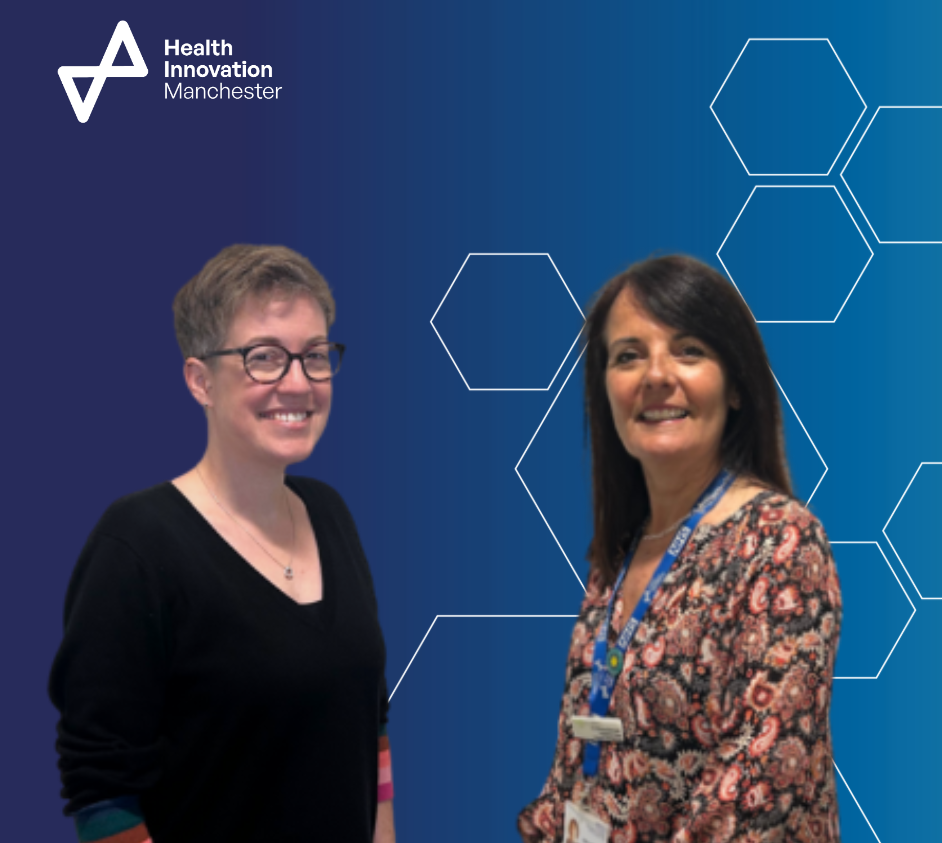
By Lauren Constable and Dr Paula Bennett
When we talk about innovation in health and care, it is easy to focus on the solution. But too often, services are designed around assumptions and do not always incorporate the wider picture, meaning they may not always be fit for purpose in the real world.
For us, co-design is not an optional extra. It is the secret ingredient that helps us understand what a pathway is really like for the people experiencing it, delivering it and navigating it. It challenges what we think we know and creates space for different perspectives to shape better solutions.

Expertise comes in many different forms
User centred design gives us the tools and insights to truly understand what people need and want from services. Co-design is part of good UCD practice and brings different types of expertise together. Clinical expertise helps us understand the health challenge and the real experiences of staff delivering care and treatment. Communities bring lived experience. Staff bring practical insight into how services actually operate. Wider system partners bring knowledge of commissioning, delivery, funding and sustainability.
Lasting innovation happens when clinical insight, human-centred design and community voices work together.
Through projects such as Community at Heart, we are using co-design and user-centred design more widely to deliberately create space for those voices to come together. The aim is not simply to ask people what they think of an idea once it has already been developed. It is to involve people earlier, so that their experience truly defines the problem, identifies the priorities and suggests the real-world changes needed.
A whole-pathway approach
One of the things we both see regularly is that people often only have visibility of their part of a pathway. If you’re a clinician, your focus is on the part of the pathway you deliver. If you’re a patient, your experience is shaped by the journey you personally take. If you’re managing a service, your focus may be on operational pressures or performance targets. But health and care pathways are often complex, interconnected systems, with decisions and experiences in one part of the pathway affecting outcomes elsewhere.
Problems can appear in one place but originate somewhere entirely different.
Co-design helps bring those connections to light: it allows people to see beyond their own experience and understand how different parts of the system interact. It helps uncover the complexities, dependencies and unintended consequences that are often hidden from view. It is critical in creating a shared understanding of the problems and then how to solve them.
This is one of the areas where we believe Health Innovation Manchester can add real value. We are in a privileged position to have a whole system view of a problem rather than a single speciality, service or perspective. Our role is to look independently across the whole system, bring the right people together and help partners understand challenges from multiple viewpoints before identifying solutions.
Progress over perfection
We accept that co-design will seldom be perfect. There will rarely be enough time, resource or access to speak to everyone, and there will always be decisions to make about whose voices are key at different stages of the work. Something we particularly focus on is bringing in the voices of those who have historically been unheard or underserved, be they staff or patients. Part of UCD is continually reflecting on whether enough has been done to understand the problem and move forward responsibly.
But doing co-design imperfectly is still better than not doing it at all.
If we wait for the perfect version, we risk doing nothing. If we start, learn, adapt and keep listening, we create a stronger platform for success. That matters because when people are involved in shaping change, they are more likely to understand it, support it and help make it work in practice. Our approach is constantly evolving, and part of that is to ensure that we designate project budget and time to incorporate co-design into the way that we work.
A few weeks ago, Health Innovation Manchester partnered with Bury College to deliver an interactive health innovation hackathon for Health and Social Care students. Working in teams, students tackled the challenge of developing innovative ways to help young people understand, care about and take action for their heart health.
The hackathon showed how young people can apply creativity to a real-world health challenge, where they shared and developed ideas around digital health, behavioural nudges, accessibility, gamification, healthy eating, social influence and education. What was more striking however was the whole experience reminded us how quickly people can think differently when they are given permission to step outside the usual constraints. The students were not validating a pre-designed solution. They were exploring a challenge from their own perspective, with energy, creativity and optimism.
It is a reminder that we should keep asking who is closest to the problem, who is affected by the outcome, who understands the constraints, and who might bring a perspective we have not yet considered.
We should look beyond health and care.
Other sectors have much to teach us about accessibility, digital engagement, behaviour change, service experience and trust. But the challenge is not to copy what other sectors do, but to learn thoughtfully and apply that learning in a way that is safe, ethical and grounded in NHS values, making it easier and more effective to access healthcare, and ensuring the process is as pain-free as possible.
A challenge for us all
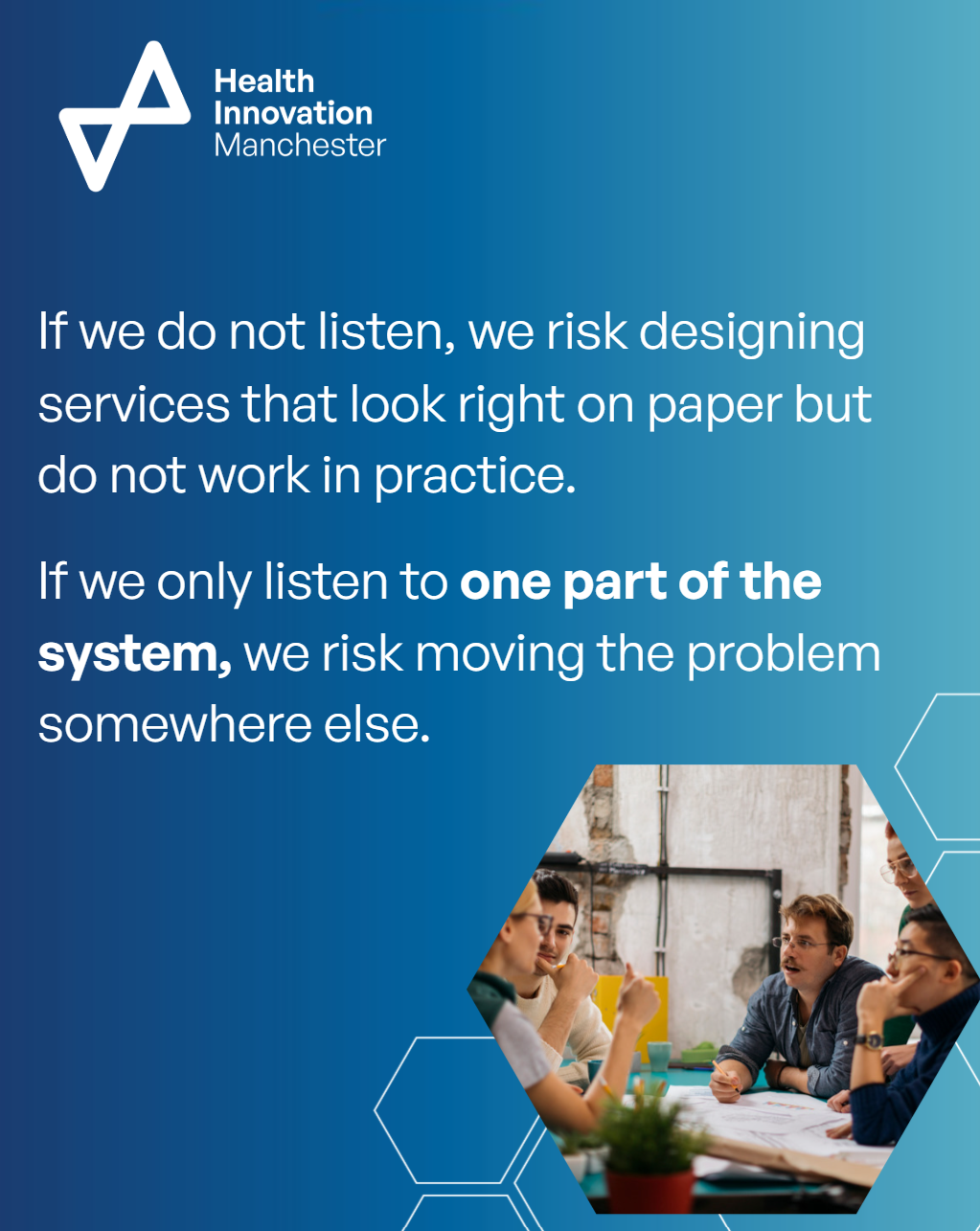
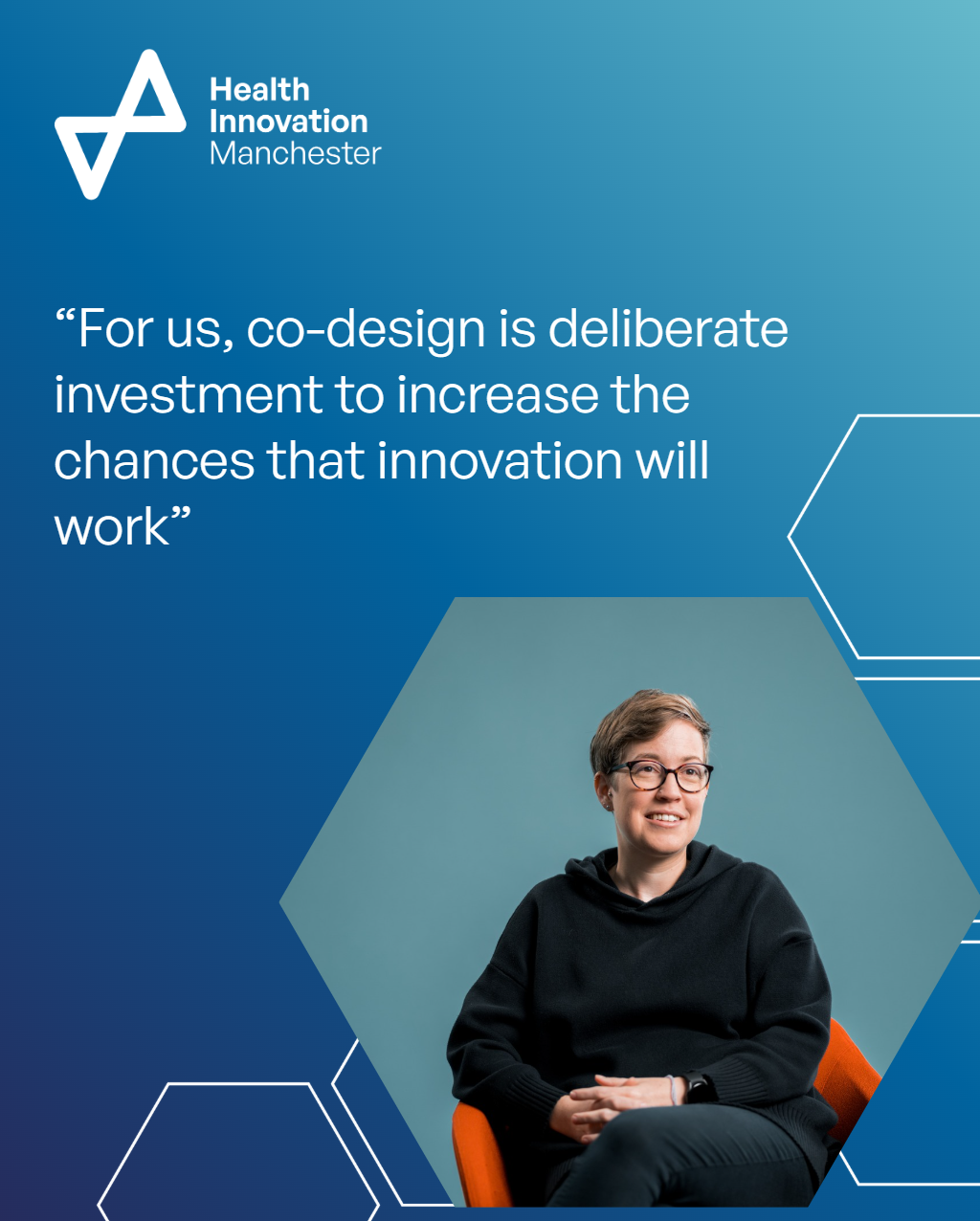
For us, co-design is not about slowing innovation down; it is deliberate investment to increase the chances that innovation will work. Because if we do not listen, we risk designing services that look right on paper but do not work in practice. If we only listen to one part of the system, we risk moving the problem somewhere else. If we start with a solution before understanding the problem, we risk missing the opportunity to make a real difference.
But when we bring the right voices together, with integrity, curiosity and a whole-system view, we can design change that is more practical, more inclusive and more likely to last.
Lauren Constable, Head of User Centred Design, Health Innovation Manchester
Paula Bennett, Chief Nurse, Health Innovation Manchester